Wedding Musical Tabla Clipart Bundle: Designs That Sing
There’s a moment in every wedding celebration when the music takes over. The rhythmic pulse of the tabla sets the pace for the dance floor, marking the transition from solemn ceremony to joyous party. Capturing that specific energy—that blend of tradition, rhythm, and festivity—is exactly what a specialized design asset allows you to do. If you are working on a project that targets South Asian weddings, fusion events, or music-centric branding, finding the right visual shorthand is crucial. You need imagery that communicates cultural authenticity and celebration instantly.
This is where the specific utility of a curated clipart bundle comes into play. We are looking at a collection designed to bridge the gap between generic stock art and custom illustration. For designers, event planners, and small business owners, the challenge is often sourcing assets that are high-resolution enough for print but versatile enough for digital screens. When you open a folder of assets, you want to know that they will work as hard as you do. That means no jagged edges when you scale up a banner, and no awkward white boxes when you layer an image over a textured background.
Visualizing Rhythm: The Anatomy of the Collection
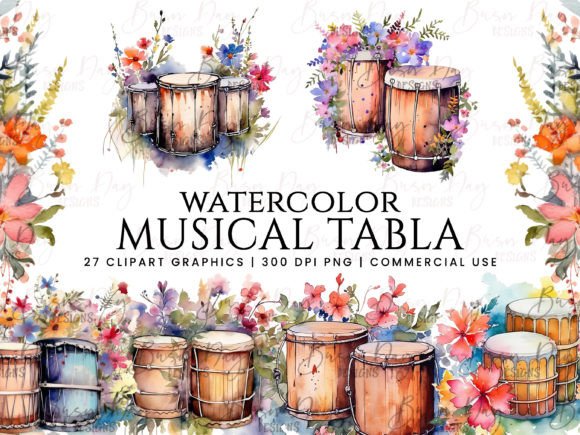
The strength of this particular collection lies in its technical preparation. We are dealing with 27 distinct PNG files. Now, 27 sounds like just a number, but in practical terms, it represents variety. When you are designing a series of social media posts or a suite of wedding stationery, repetition can be the enemy of engagement. Having 27 variations means you can use a different style of tabla or a different arrangement of musical notes for the "Save the Date," the "RSVP," and the "Thank You" card without repeating the exact same graphic.
The files come with transparent backgrounds. If you have ever tried to cut out a complex object with a pen tool in Photoshop, you know what a time-saver this is. It allows for immediate drag-and-drop functionality. Whether you are placing the tabla over a deep burgundy velvet background for a luxury invite or layering it over a candid photo of the couple, the asset blends in seamlessly. Furthermore, the resolution is set at 300 DPI with dimensions of 4000x4000 pixels. This is the industry standard for high-quality print. You can blow these images up to roughly 13 inches at full resolution without losing clarity, making them perfect for large-format printing like wedding signage or backdrops.
Beyond the Invite: Practical Applications for Branding and Marketing
While the immediate use-case seems to be wedding invitations, the scope of this clipart bundle extends much further into the world of branding and marketing. Think about the visual language required for a musician, a fusion restaurant, or a dance academy. These industries rely heavily on visual cues that suggest sound and movement.
Here is how you can leverage these assets across different platforms:
- Social Media Strategy: Instagram and Pinterest are highly visual. You can use these cliparts as watermarks on your photography or as distinct graphic elements in your Stories. For a musician’s Instagram grid, alternating between text posts and images featuring these musical elements creates a cohesive aesthetic that screams "audio professional."
- Packaging Design: If you sell products—perhaps artisanal spices, tea blends, or cultural merchandise—packaging is your silent salesperson. A subtle musical motif on the side of a box or on a hang-tag adds a layer of cultural storytelling without cluttering the design.
- Digital Products: The digital download market is booming. If you are creating templates for Canva or selling digital planners, having a library of high-quality, transparent PNGs allows you to create premium products. You can offer a "Wedding Suite" template pack where these musical elements are pre-loaded for the user.
- Editorial Layouts: Bloggers and magazine editors often struggle to find art that isn't overused. Using these specific illustrations for articles about wedding planning, music theory, or cultural heritage adds a unique editorial flair that stock photos often lack.
Ensuring Visual Consistency and Brand Recognition
One of the biggest hurdles in design is maintaining consistency. When you mix and match assets from different sources, your brand identity can look disjointed. Using a single bundle for your musical-themed projects ensures that the line weight, color palette potential, and artistic style remain uniform.
For a small business owner, this uniformity translates to brand recognition. When a client sees that distinct style of illustration on your flyer, and then sees it again on your website header and your business card, they start to associate that visual style with your service. It builds trust. It says, "I pay attention to details."
Consider the "Logo Design" application. While you wouldn't necessarily use a pre-made clipart as the entire logo (due to exclusivity issues), these elements serve as fantastic supporting graphics or the basis for a logomark. You could take a specific drum illustration, vectorize it, and stylize it to create a unique icon for a music production company. The high resolution of the source file makes this conversion process much cleaner than starting with a low-res JPEG.
Matching Assets to Project Goals
When selecting assets, you have to think about the "vibe" of your project. The Wedding Musical Tabla Clipart Bundle carries a specific energy—it is rhythmic, cultural, and celebratory. It pairs exceptionally well with typography that shares those traits.
If you are designing for a high-end, traditional wedding, you might pair these images with a serif font or an elegant script font. The contrast between the organic shape of the drum and the structured baseline of a serif typeface creates a balanced composition. Conversely, if the project is for a modern fusion event or a youth-oriented music festival, you would want to pair the clipart with a bold display font or a clean sans serif font. This keeps the design looking fresh and contemporary.
Don't be afraid to mix your assets. Use the clipart for the hero image and rely on your typography to do the heavy lifting for the information. The clipart draws the eye, but the font hierarchy guides the reader through the details. This interplay between image and type is the hallmark of professional graphic design.
The Technical Edge: Why Resolution Matters
It is worth reiterating the importance of the 300 DPI specification. In the world of web design, 72 DPI is often sufficient because screens render pixels differently. However, the moment you move to print materials—posters, brochures, merchandise—low resolution becomes your worst enemy. Pixelation makes a brand look amateur.
Because these files are provided as high-quality PNGs, they are ready for the print shop. You can hand these files off to a printer for a large vinyl banner or a set of custom napkins without fear of rejection. This saves you money in the long run; you don't have to hire an illustrator to recreate the art at a higher resolution.
Additionally, the transparency allows for complex layering. You can place a text box over part of the image, or have the drum "breaking the frame" of a border. This adds depth to your creative projects. Flat design is safe, but layered design is engaging.
Final Thoughts on Asset Management
Treat this bundle not just as a collection of pictures, but as a toolkit. For the creative entrepreneur or content creator, having a folder of go-to assets that you have licensed for commercial use removes the friction from the creation process. You aren't scrambling to find an image at the last minute; you are selecting from a curated library you already own.
Whether you are building a brand identity for a wedding singer, designing a menu for a new restaurant, or crafting digital content that celebrates musical heritage, these assets provide the professional polish needed to stand out. They offer a blend of cultural significance and technical quality that generic clipart simply cannot match.